


Today, Maximum—Randy Fernando’s third company (with two prior exits)—is coming out of stealth. Eight months ago, the company raised a $30M seed round led by CRV, with Pear VC as the second-largest check, to build a modern, AI-powered operating system for banks.
This one is personal, so I wanted to tell it the way it actually happened.
In 2020, I met Randy just as he was starting Power. This was his second company after he’d sold his first, Vault, to Acorns. That’s when I learned he’s a special type of entrepreneur, and I was fortunate to write one of the first checks into Power.
Power built the API layer that let companies launch and run their own credit card programs, with banks as the issuing partners behind the scenes. Two years later, Marqeta acquired it for $300M. When Marqeta sent Randy the offer, I was the first call he made. I’d recently been through an acquisition myself and was able to share perspective. Post-acquisition, Randy stayed on to help scale what he’d built inside a much bigger, public company.
That’s the resume version. Here’s the part that actually explains why I’m writing this post.
A San Francisco evening in 2021
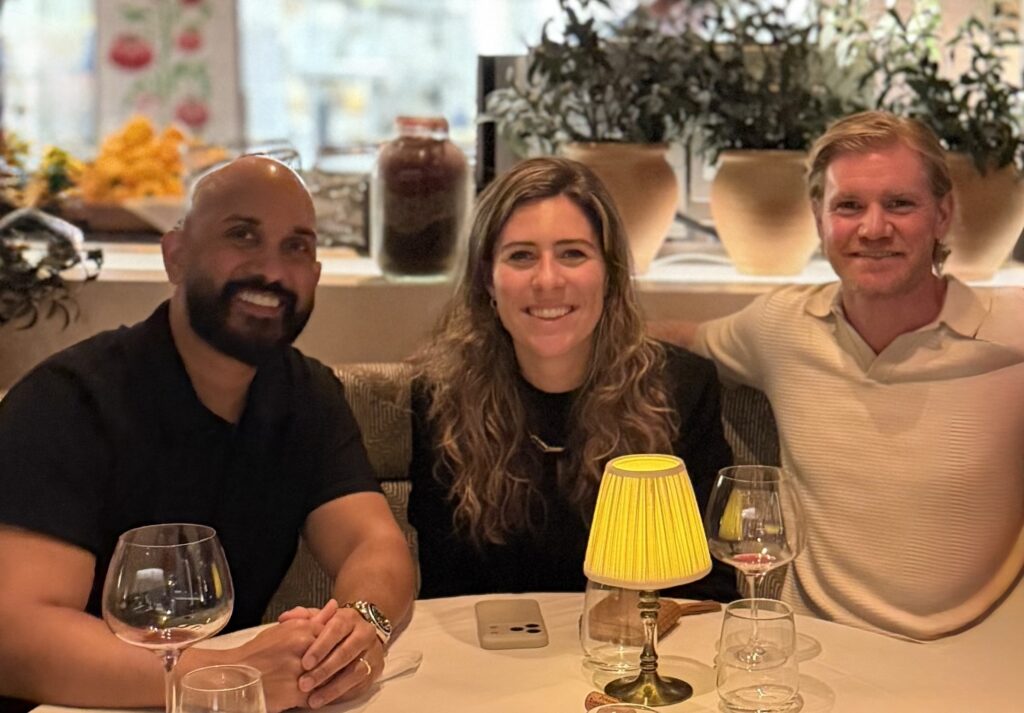
Randy was living in Portland while he first started Power, which meant trips to San Francisco to meet with clients and investors. On one of those early trips, I told him to crash at my place in SF. My wife, who happens to be from Brazil, prepared a Brazilian meal that night for the three of us, the kind of dinner that takes hours and tastes like it, and we sat around the table for what turned into one of those evenings you don’t forget. We didn’t discuss Power, or venture, or startups. We talked about the past, shared personal stories about childhood, drank wine, and laughed late into the night.
I don’t think Randy remembers that evening as a turning point for Power, because it wasn’t one. But I’m guessing he’d remember it the same way I do: as the moment our relationship shifted from founder-investor to friendship. I was flattered, though not surprised, to be one of the first people he told that he was going to start something new.
When he shared his vision for Maximum, and the plan for building it, it was clear we should take things seriously. Randy’s ability to articulate a genuinely complicated plan in plain terms came through immediately, again. It was obvious this was an ambitious undertaking, aiming to replace decades-old financial infrastructure and challenge multi-billion-dollar incumbents, and that Randy was the best possible founder for the job.
I’d been one of his first checks at Power. This time, my phone rang before he’d built anything at all.
Why we invested
Randy has a rare depth of knowledge in FinTech and financial services, the kind that cannot be taught and can only be forged through years of building and operating across large companies (JPMorgan, Marqeta) and small ones (Vault, Acorns, Azlo, Power).
Randy is sharp. His journey is even more impressive when you think about his nontraditional path to Silicon Valley. He doesn’t have a PhD from MIT or MBA from Stanford, but he doesn’t need those credentials. Randy uniquely understands business and people. One of his many superpowers is his ability to lead. Not surprisingly, this translates into hiring, fundraising and selling in ways that are rare.
He’s a very clear and concise communicator. Spend time with him and you quickly see how he articulates his vision. He has a unique view of the financial market and an earned secret on how to attack it.
He has a gravitas that is hard to ignore. When Randy speaks, people tend to listen.
At Pear, we talk a lot about how to identify, and ideally invest in, top 1% founders. One of our internal tests is simple: “Would I work for this founder?” Randy meets that bar, which by definition is extremely rare.
His thesis for Maximum sounds simple, but the ambition is massive. The core banking systems that run most of America’s banks were built on technology from the 1970s, and patching them isn’t a strategy anymore. FIS, Fiserv, and Jack Henry still power the deposit, lending, and ledger rails underneath the banks all of us use, and those systems are showing their age: outages, brittle integrations, and a growing bill just to keep the lights on.
Maximum is building the replacement, a cloud-native, AI-powered operating system for banks, with the ledger, compliance, payments and risk infrastructure designed for a world of real-time money movement instead of overnight batch jobs.
We’ve seen this movie before, because we watched Randy direct it once already. At Power, he and his team built the orchestration layer that let companies more easily integrate with partner banks, accelerating time-to-market and their ability to scale, and in doing so, they created a category that didn’t exist before them. Maximum is a similar concept pointed at a much larger target: instead of sitting on top of the old core banking systems, it aims to replace them outright. Spoiler alert, much of the leadership team from Randy’s previous companies is back at it together again with Maximum.
What convinced us wasn’t just the market (global banking technology is a $760B+ opportunity today, headed past $1.1T by 2029) or the technical ambition. It’s Randy’s conviction. He founded Maximum and raised this seed round with nothing but an idea: no cofounder, no product, no traction, no deck. Just a six-page memo (yes Randy, I’ve got the receipts). CRV, another early investor in Power, led the round, and we came in as the second-largest check.
I’ve since joined Maximum’s board as an observer.
What’s next
Maximum has quietly assembled an all-star team. Most previously worked together at Power, with others joining from Robinhood and BlackRock. They’re now bringing their ledger and AI-powered core to market, with the first bank customers coming on board as I write this.
Congratulations to Randy and the whole Maximum team. I’m proud to be along for round two.
Share


