
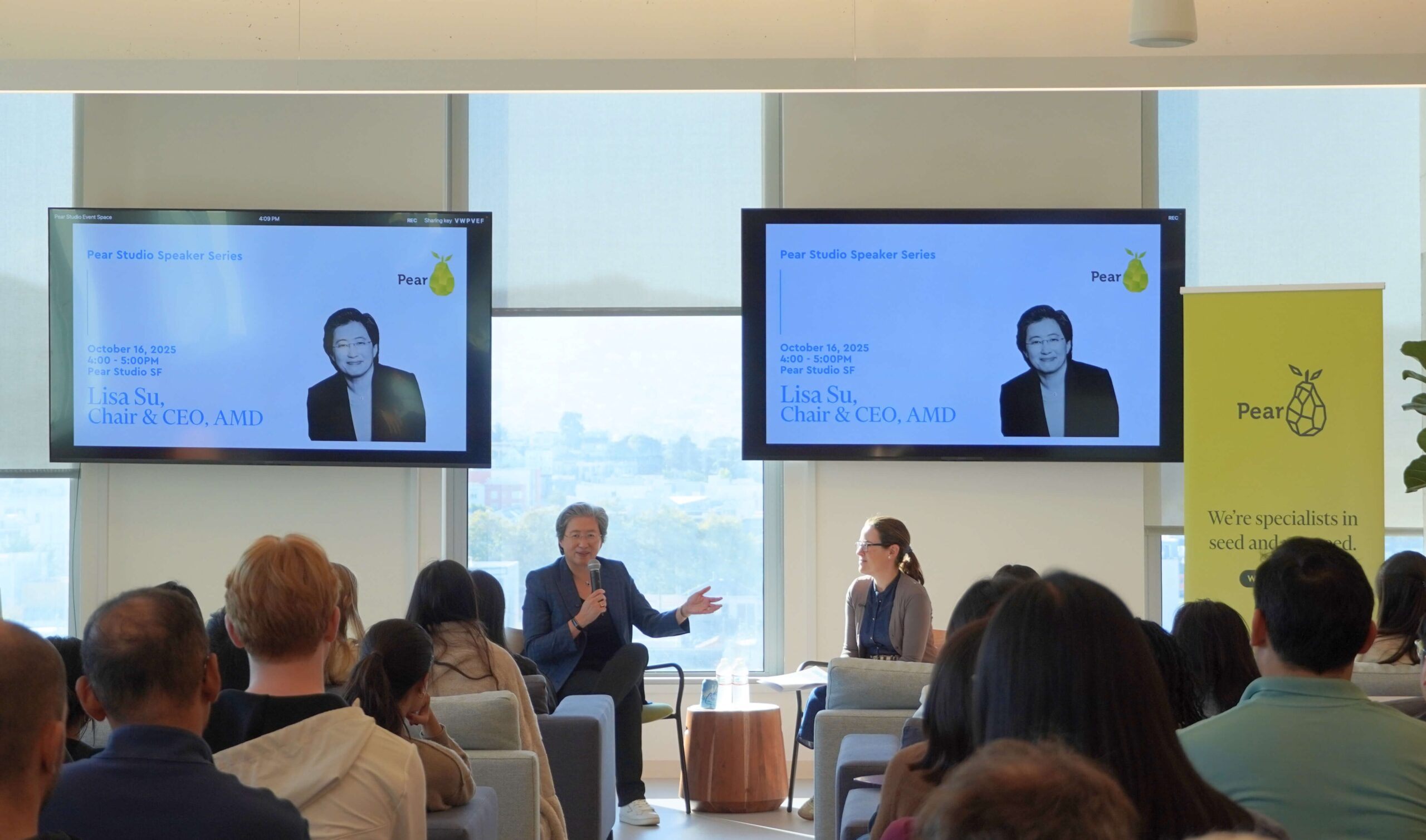
At Pear, we’re fortunate to learn from some of the world’s most visionary leaders, and few exemplify focus and perseverance like Dr. Lisa Su, Chair and CEO of AMD.
As the head of one of the most important technology companies in the world, Dr. Su has led AMD’s transformation into the industry’s leader in high-performance and adaptive computing—helping tackle some of the world’s hardest challenges through next-generation AI and computing solutions.
We recently had the privilege of welcoming Dr. Su to Pear Studio for a fireside chat with Pear’s founding managing partner, Mar Hershenson. The event was made possible thanks to PearX S24 alum Susie Wee, Co-Founder and CEO of DevAI, who first introduced us to Dr. Su.
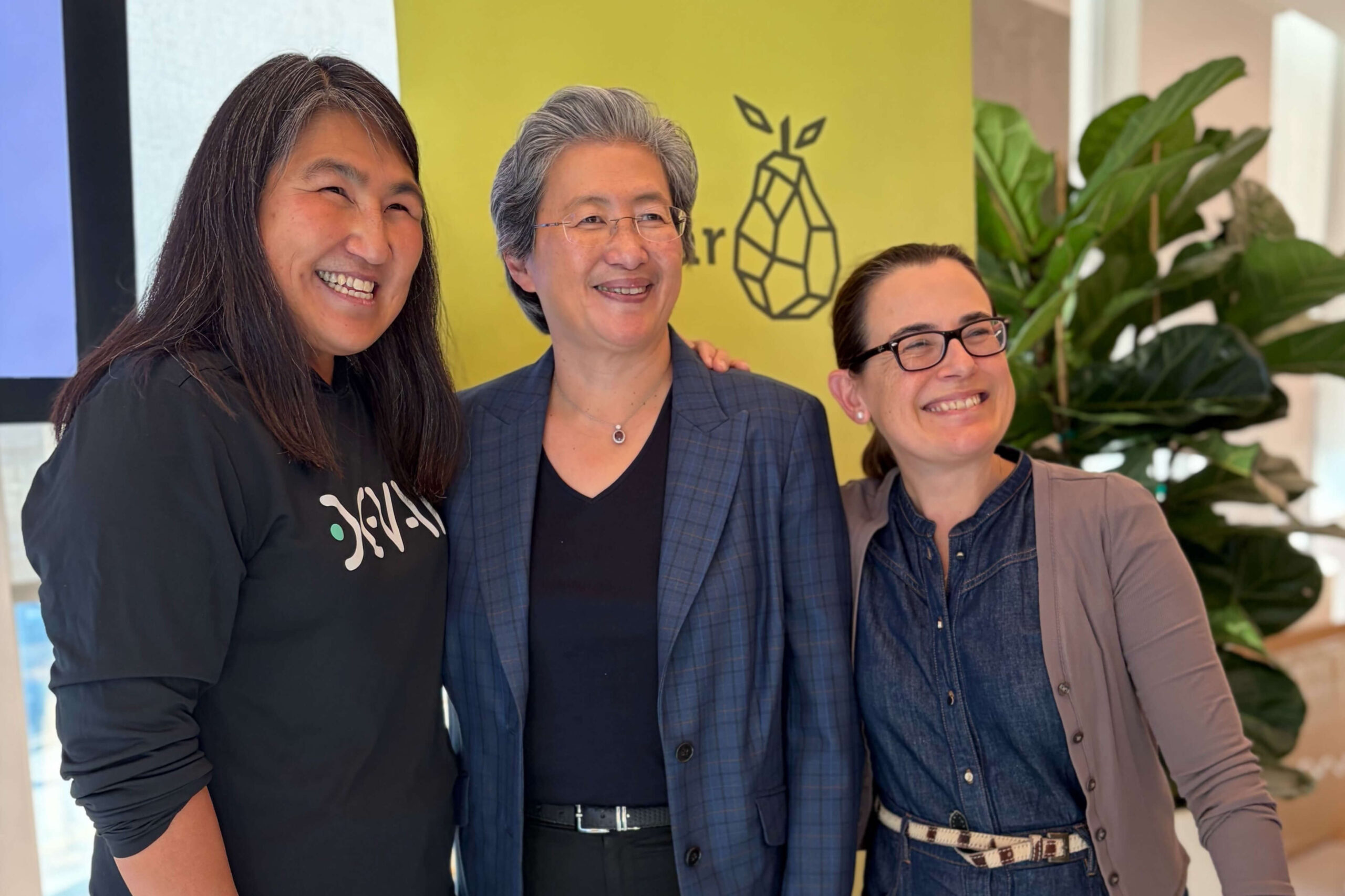
In a packed room of founders and builders, Dr. Su reflected on her journey from MIT PhD to one of the most influential CEOs in the world and shared hard-earned lessons on leadership, learning, and long-term vision.
Here are five takeaways every founder and CEO can apply from Dr. Su’s remarkable journey.
1. Choose hard problems—they teach you how to think
Dr. Su’s journey began with a curiosity for how things work and the willingness to take on problems that seemed unsolvable.
As a PhD student at MIT, she worked on an early, challenging technology for semiconductor interconnects that many considered impossible at the time. That experience taught her persistence and rigor—skills that became the foundation for her career.
“My PhD taught me how to think about problems,” she said. “I started not knowing anything about silicon on insular devices, and by the end of the four years I was an expert in the field. That [experience] gives you so much confidence in terms of how to solve problems.”
For Dr. Su, learning and stretching beyond what you know doesn’t require a PhD. It comes from choosing roles that push you to keep growing.
What’s really important is to go into an environment where you’re going to learn. The more you learn, the more opportunities you have, and the better you’re able to round out your skills.
She added, “The key is to find yourself in a spot where you’re constantly learning new technical, business, and leadership skills and solving new problems each day.”
2. Focus beats breadth, especially in a turnaround
When Dr. Su became CEO in 2014, AMD was at a crossroads. The company had missed major product cycles and was losing ground to competitors. Nearly 95% of its business came from PCs, a market quickly declining as the world shifted toward smartphones. Many urged AMD to follow that trend.
“We had to decide what we wanted to be when we grew up,” she said.
Her answer: focus.
Instead of chasing new categories, Dr. Su doubled down on AMD’s core strength: designing the world’s most complex, high-performance processors.
“I thought that we could fundamentally disrupt the high performance processor business,” Dr. Su said. “And that’s what we set out to do. We told our board and our shareholders that it would take us five years.”
That bet paid off. Under Dr. Su’s leadership, AMD rebuilt its product portfolio and grew its data center CPU market share from about 1% to more than 40%.
“As founders, you’ll have to decide where you want to focus. Those are probably the most important decisions. Once you decide, you have to put together the plan that allows you to do that. And it may take a while. Tech is not something you can be impatient with.”
3. Build through partnership, not isolation
Throughout her career, Dr. Su has championed open collaboration as a key driver of innovation.
There’s no one who has a monopoly on all the good ideas. The way you get the best ideas is when you bring the best of all the different ecosystems together. We want to major on being a great partner.
This philosophy has guided AMD’s approach to building an open ecosystem, one that welcomes collaboration across hardware, software, and data to create better solutions for customers. It has also shaped recently announced partnerships with companies like OpenAI and Oracle, which are focused on co-designing hardware and software for the next generation of AI infrastructure.
“We’re in a place where AI is moving so fast,” said Dr. Su. “My goal in life is to make sure all of you have more compute than you ever need. Our job is to build the infrastructure so that you can discover all the wonderful things. And that requires partnership everywhere in the ecosystem.”
She added, “I’m a big believer that partnerships should always be win-win. Part of that means figuring out the motivation of your customer or partner so they’re motivated to see you be successful as well.”

4. Take the long view on AI—it’s just getting started
When asked about the future of AI, Dr. Su was clear: this moment isn’t a bubble—it’s a beginning.
“People ask me all the time, how can companies be spending this much money on AI? There must be a bubble, right?” she said. “And I tell them, no. Because those of us in the industry can see that we’re still just scratching the surface of what AI is capable of.”
Despite the remarkable progress over the past two years, today’s AI systems are still far from their full potential. “The models are much better than they were even three months ago,” she said. “But they’re not nearly as good as they can be.”
For Dr. Su, AI will define at least the next decade of computing, and breakthroughs in hardware performance, developer tools, and system design will continue to unlock new levels of intelligence.
“Smart developers can get more out of it,” she explained, “and more compute will give us more intelligence.”
Dr. Su believes we’re only about two years into what will be a ten-year transformation, one that will reshape industries and accelerate innovation across every field. “Being early in that [cycle] gives us a lot of opportunity going forward,” she said.
5. Learn from mistakes, and connect the dots
Dr. Su is a lifelong learner, but not in the traditional sense. Her most meaningful lessons have come from experience, especially from failure.
“I’d say my biggest learning moments were the times that I’ve screwed up the most,” she shared. “You actually learn from your mistakes a lot more than you learn from your successes.”
At AMD, that philosophy shapes how she leads teams. “We spend time looking at why a product didn’t work the first time,” she said. “What did we learn from that? Why did a quality issue come up and how can we make the next rev better?”
That same mindset extends to how she stays sharp in a fast-changing industry. “Every morning I wake up and think, what happened overnight?” she said. “It’s such a dynamic world, and every day there’s something new. The goal is to understand what’s happening and put the pieces together.”
For Dr. Su, leadership is as much about synthesis as it is about strategy. “The most important thing you can do as a leader,” she explained, “is integrate the information you get from different places. You have experts who will tell you things, but the ability to connect the dots and make good, integrated decisions is really important.”
Thank you to Dr. Lisa Su and her team for joining us at Pear!