
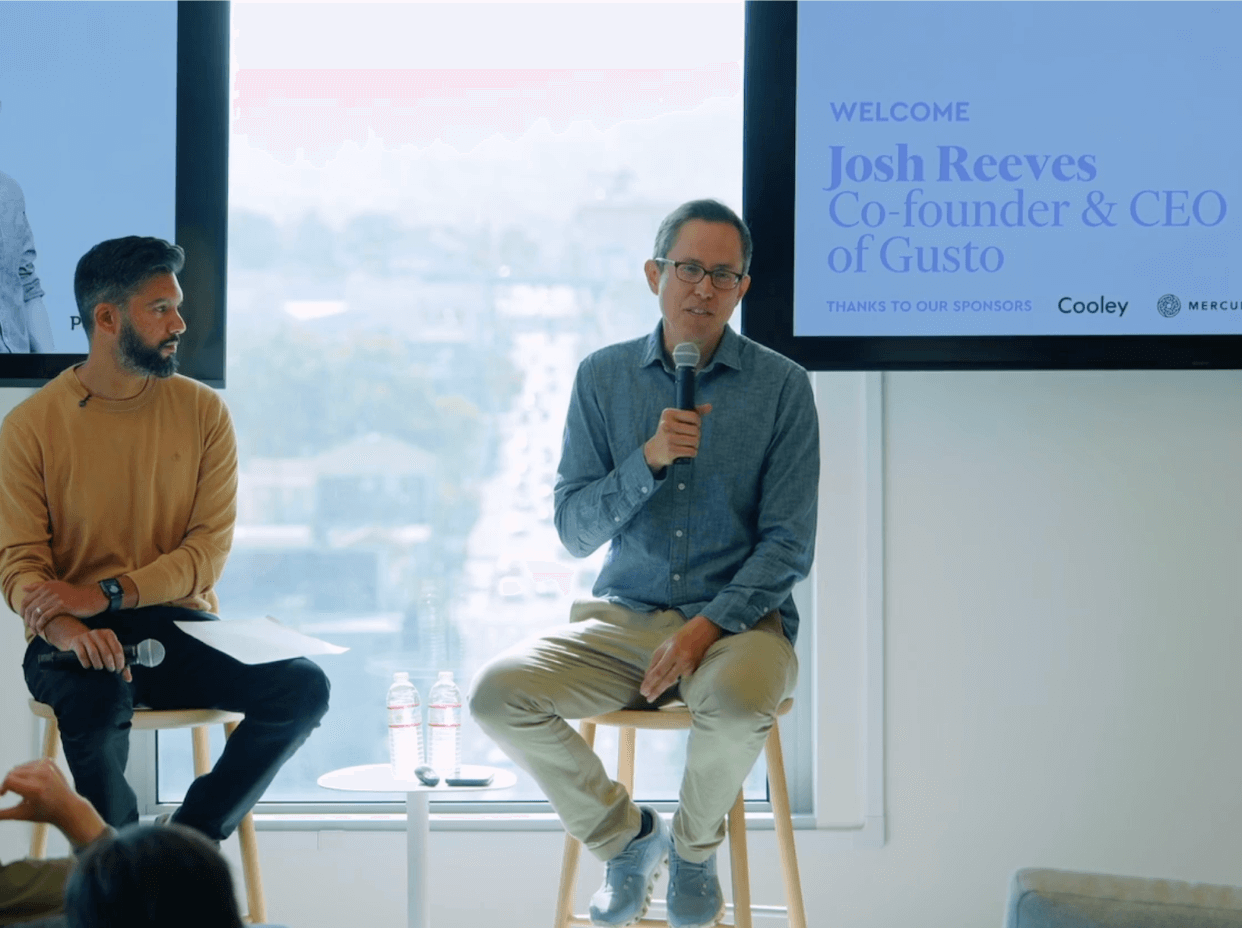
When Josh Reeves co-founded Gusto (originally ZenPayroll) in 2011, he and his two co-founders weren’t payroll experts. They were Stanford electrical engineering PhD dropouts who previously ran small startups, and they all felt how painful it was to set up payroll, health benefits, and compliance. It quickly became apparent that a lot of other small business owners felt pretty frustrated with the same things.
“We were eager to tackle a problem that we could see ourselves spending the rest of our life really trying to make better. And so it had to be big,” Josh said.
Fourteen years later, Gusto has nearly 3,000 employees and powers payroll and benefits for hundreds of thousands of small businesses. Josh joined the PearX S25 Speaker Series to share lessons from building a company in a market most incumbents ignored.
Here are five of the best takeaways for founders.
1. Look where incumbents won’t
When they started, payroll was dominated by billion-dollar incumbents. But Josh noticed something strange: 40% of U.S. small businesses were still running payroll manually, with pen and paper.
“You add up all these folks with huge market caps and you’re like, what? There’s still 40% of companies doing it manually? That doesn’t make any sense,” Josh recalled. “It turns out these bigger incumbents didn’t like to focus on small business.”
For founders, this is a reminder that a market can look “saturated” from the outside, but huge gaps often remain, especially where incumbents ignore segments that feel too small or too hard to serve.
2. Get in the trenches with your customers
The first version of Gusto wasn’t self-serve software. It was Josh’s co-founder showing up at customers’ homes with his laptop and doing a lot of hand-holding.
“Using ZenPayroll meant calling my co-founder’s cell phone. It meant him coming to your house whenever you needed him to, so totally non-scalable. But it was a way for us to get more volume and get to millions of dollars moving through the system with accuracy, compliance.”
Before raising more capital, they first wanted to prove to themselves that they could tackle the most complex technical challenges. They figured out how to build the software to move real payroll dollars, ensuring credibility with investors and confidence in themselves.
3. Build a product people want to recommend
In the first year, Gusto reached 1,000 customers without spending a dollar on ads.
“We didn’t do any paid acquisition for a year. We got to a thousand customers purely through word of mouth,” Josh shared. “We’ll add 150,000 customers this year and the majority of that is word of mouth.”
His advice for early founders: build an initial product that people love and want to recommend. Once you figure out the product and organic inbound, you can layer on paid acquisition strategies.

4. Build daily rituals with intentionality
Josh avoids the word culture (it has so many definitions that it just becomes baggage) and instead breaks it down into values, traditions, and scaffolding.
“Who you hire, how you hire, how you onboard, how you pay, how you promote, how you terminate, how you communicate. That’s like, frankly, where I spend the bulk of my time. That’s actually what it means to be a leader.”
One tradition: every Gusto job offer is delivered by the entire interview panel, with each person sharing why they’re excited to work with the candidate. It’s a reminder that culture isn’t abstract. Culture is actually the daily rituals that define how you hire, onboard, promote, and lead.
5. Plan in short bursts
Even with nearly 3,000 employees, Gusto still plans in six-week cycles. “We operate on a six-week cycle time: what are we doing this six-week cycle versus the next six-week cycle.”
Planning is a useful way to drive alignment and focus on what your team is doing now versus later, but be careful not to get stuck.
“Don’t get caught up in perfect or lock yourself in a room for six months and build something…you need feedback loops,” Josh said. “Even at our scale, six weeks feels like the longest it should be.”
Why plan at all? Josh shared a fun metaphor. Imagine you’re planning a trip to Lake Tahoe and you’re just winging it. With three people, fine. With 20, maybe. But with 50+ employees, you can’t just show up at a restaurant and expect to be seated.
For Josh, building Gusto has always been about serving the overlooked small business owner. And the big lesson for founders: markets can look “crowded,” but the real opportunity is often hiding where incumbents won’t go.
If you want to access more raw founder conversations, check out some of our upcoming events. If you’re a founder and interested in joining the next cohort of PearX, stay in touch by subscribing to our newsletter and apply now to PearX W26. Deadline is September 13th.